Introduction
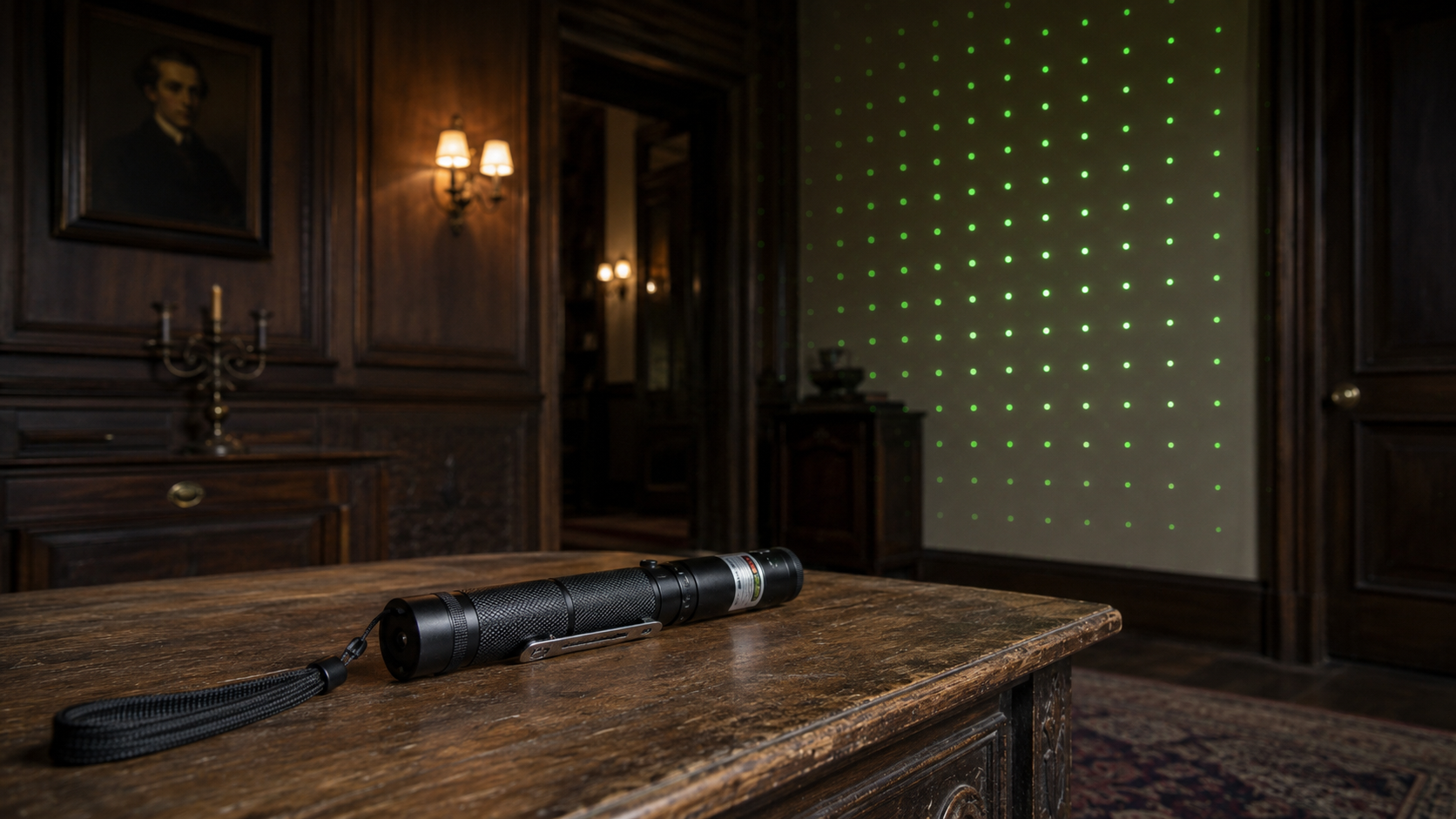
During a paranormal investigation, you may see a small device projecting hundreds of green or red points of light across a wall, doorway or empty room.
This equipment is commonly known as a laser grid.
Laser grids are used by paranormal investigators as visual monitoring tools. The projected pattern creates a fixed reference across an area, making movement or changes within that space potentially easier to notice.
If a person, object, insect or other physical obstruction passes through the projected light, parts of the pattern may become blocked, distorted or appear to move.
Some investigators use laser grids while observing a room directly. Others record the projected pattern with a camera or camcorder so the footage can be reviewed later.
However, a laser grid does not detect ghosts, spirits or paranormal energy. It projects light and allows investigators to observe changes within that light.
This guide explains what a laser grid is, how it works, why paranormal investigators use one, what can affect the projected pattern and why any unusual observation requires careful investigation.
What Is a Laser Grid?
A laser grid is a small device that projects a pattern of laser points across an area.
Instead of producing a single laser dot, the device uses an optical component to divide the beam into many separate points.
Depending on the model, the projected pattern may appear as:
- A grid of evenly spaced dots
- A wide field of scattered points
- A circular arrangement
- A rectangular pattern
- A dense cluster of laser points
Green laser grids are particularly common during paranormal investigations because green light is generally easy for the human eye and cameras to see in dark conditions.
Red laser grids are also available, although the projected pattern may appear less prominent depending on the room, camera and lighting conditions.
The device does not scan the room or measure movement. It simply projects a pattern of light.
Investigators then observe or record that pattern to look for visible changes.
How Does a Laser Grid Work?
A laser grid contains a laser light source and an optical element that divides the original beam into multiple points.
When the device is switched on, the points spread out as they travel away from the projector.
The farther the laser grid is positioned from a wall or surface, the wider the projected pattern may become.
For example, placing the device close to a wall may produce:
- A small pattern
- Bright points
- Closely spaced dots
Moving it farther away may produce:
- A larger area of coverage
- More widely spaced points
- Less intense individual dots
The exact result depends on the design and power of the device.
The laser points usually remain stationary unless:
- The projector moves
- The surface moves
- Something passes through the beams
- The device is disturbed
- The mounting surface vibrates
A laser grid is therefore a visual reference rather than an automatic detector.
Why Do Paranormal Investigators Use Laser Grids?
Paranormal investigators may use laser grids to make movement within a selected area easier to observe.
In a dark room, it can be difficult to judge:
- Distance
- Depth
- The position of objects
- Small movements
- Changes within an empty space
A projected grid provides visible reference points throughout part of the room.
Investigators may use a laser grid to monitor:
- Doorways
- Corridors
- Staircases
- Empty rooms
- Reported areas of movement
- Locations where shadow figures have been reported
- Areas containing trigger objects
- Spaces being recorded by a static camera
If something moves through the projected light, some of the points may be blocked or distorted.
The grid may help draw attention to movement that could otherwise be difficult to notice in darkness.
However, the laser grid cannot identify what caused a change.
Does a Laser Grid Detect Movement?
No.
A standard laser grid does not contain a motion sensor and does not automatically detect movement.
It projects a fixed pattern of light.
Any change must normally be:
- Seen by an investigator
- Recorded by a camera
- Observed during later video review
If part of the pattern disappears, changes shape or appears to move, investigators must determine what may have interrupted the projected light.
Possible causes include:
- A person
- An insect
- Dust
- Smoke
- Mist
- A moving object
- A camera changing focus
- Movement of the laser projector
- Movement of the surface receiving the light
The laser grid provides a visual effect that can be observed. It does not analyse or explain that effect.
How Is a Laser Grid Used During a Paranormal Investigation?
Before using a laser grid, investigators usually select an area they want to observe.
The device may be positioned:
- On a table
- On a tripod
- On a shelf
- On a stable piece of equipment
- On the floor where it will not create a trip hazard
The laser is then aimed towards a wall, doorway or open area.
Once the pattern is visible, investigators may:
- Check the coverage.
- Make sure the device is stable.
- Record its position.
- Note the direction in which it is pointing.
- Check for reflective surfaces.
- Observe how the pattern appears normally.
- Begin direct observation or video recording.
The room may then be monitored while an investigation session takes place.
If investigators believe the pattern changes, they should note:
- The time
- Where the change occurred
- What the change looked like
- Who was present
- Where everyone was positioned
- Whether anyone moved
- Whether doors or windows were open
- Whether insects or airborne particles were visible
- Whether the projector had been disturbed
- Whether a camera recorded the event
This information can provide useful context during later review.
Where Should a Laser Grid Be Positioned?
Positioning can significantly affect how useful the projected pattern is.
A laser grid should be placed on a stable surface where it is unlikely to be touched or knocked.
Suitable locations may include:
- A secure table
- A stable tripod
- A fixed shelf
- A protected position near a wall
The device should not be placed:
- In a walkway
- On an unstable surface
- Where guests may accidentally touch it
- Where it could block an entrance
- Near the edge of a table
- Where it creates a trip hazard
- Where the beam may shine directly into someone’s eyes
The projected pattern should ideally cover the area being investigated without causing unnecessary risk.
Should a Laser Grid Be Projected onto a Wall or into a Room?
Both methods may be used, but they create different observations.
Projecting onto a Wall
When a laser grid is aimed directly at a wall, the points create a visible pattern on the surface.
This can make it easier to notice:
- Movement across the wall
- Shadows
- Changes to individual points
- Movement of objects in front of the wall
However, the visible dots only show where the beams reach the wall.
Projecting Across an Open Space
A laser grid may also be projected through a room towards a distant wall.
The beams pass through the open space before reaching the surface.
If something physically passes through the beams, parts of the projected pattern may be interrupted.
The laser does not create a solid sheet of light. There are spaces between the individual beams.
A small object could therefore move between the laser points without noticeably changing the pattern.
Can a Laser Grid Show the Shape of a Person?
If a person stands between the laser grid and the projected surface, their body may block many of the beams.
This can create a recognisable silhouette or dark area within the pattern.
The effect occurs because the person physically prevents some of the laser light from reaching the wall.
The shape may change as the person moves.
However, not every interruption will form a clear silhouette.
The appearance depends on:
- The distance from the projector
- The distance from the wall
- The density of the laser points
- The size of the obstruction
- The angle of the projected pattern
- The camera position
A partial interruption may appear as only a few missing or moving points.
What Can Cause a Laser Grid Pattern to Change?
Many ordinary factors can affect a laser grid.
People Moving
A person walking through the projected area may block or disturb multiple points.
Even movement near the edge of the grid may create a noticeable change.
Investigators’ Hands or Equipment
A hand, camera strap, torch or piece of equipment may briefly interrupt the beams.
In darkness, the cause may not be immediately obvious.
Insects
Flying insects may pass through the projected light.
Depending on their distance from the projector and camera, they may create:
- Brief interruptions
- Moving shadows
- Bright reflections
- Blurred shapes
Dust
Dust may reflect laser light, particularly when close to a camera lens.
Individual particles are unlikely to create a large human-shaped interruption, but they may appear as moving points or brief flashes.
Smoke, Fog and Mist
Airborne moisture or particles can make parts of the laser beams visible.
This may create the appearance of moving lines or shifting light.
Artificial fog should not normally be introduced during an evidence-led investigation because it may make later observations more difficult to interpret.
Movement of the Projector
Even a small movement of the laser device can cause the entire projected pattern to shift.
Possible causes include:
- Someone touching the table
- Floor vibration
- Footsteps
- An unstable tripod
- Loose mounting equipment
- A cable being moved
If many or all of the laser points move together, the projector should be checked.
Moving Surfaces
Curtains, doors and hanging objects may move through the projected pattern.
A wall is normally stationary, but a grid aimed at fabric or another flexible surface may appear to move as the material shifts.
Camera Movement
If the camera moves while recording the grid, the entire pattern may appear to change position within the video.
The laser may have remained completely stationary.
Camera Focus
Automatic focus may struggle in dark conditions.
As the camera searches for focus, laser points may appear:
- Larger
- Smaller
- Blurred
- Sharper
- Brighter
- Dimmer
This can create the impression that the pattern is changing.
Automatic Exposure
A camera may automatically adjust brightness when people, torches or other lights enter the scene.
The laser points may temporarily appear brighter or less visible.
Can Dust Create a Figure in a Laser Grid?
Dust can reflect light and may appear unusual when recorded by a camera.
However, a single dust particle is unlikely to block enough separate laser beams to create a detailed human-shaped silhouette.
Multiple particles, camera movement, focus changes or compression may create more complicated visual effects.
Investigators should avoid assuming that every unusual shape is caused by dust, but dust should be considered alongside other ordinary explanations.
The original video should be reviewed rather than relying only on a screenshot.
Can Insects Affect a Laser Grid?
Yes.
Flying insects are common in historic buildings, basements, attics and outdoor locations.
An insect passing through the projected area may:
- Block individual laser points
- Reflect laser light
- Cast a moving shadow
- Appear blurred when close to the camera
- Create a bright trail during a longer exposure
Infrared cameras may make insects especially noticeable because the insect can strongly reflect infrared illumination.
Investigators should review several frames before and after an unusual observation.
An insect may be difficult to recognise in a single image but become obvious when its movement is viewed across the full video sequence.
Is a Laser Grid the Same as a Motion Sensor?
No.
Although both devices may be used to monitor an area, they work differently.
Laser Grid
A laser grid:
- Projects visible points of light
- Does not automatically detect movement
- Requires direct observation or video recording
- Provides a visual reference
- Does not normally produce an alert
Motion Sensor
A motion sensor:
- Uses a sensor to respond to certain environmental changes
- May activate a light, sound or alarm
- Can operate without someone continuously watching it
- Has a defined detection method and range
A laser grid may help investigators see movement, while a motion sensor may provide an alert when its detection conditions are met.
Neither device can determine whether an activation or observation is paranormal.
Is a Laser Grid the Same as a Structured Light Sensor?
No.
Some advanced camera systems use structured light to measure depth or create three-dimensional information.
These systems may project infrared patterns and use cameras or sensors to calculate distance.
A standard paranormal investigation laser grid does not normally measure depth or create a three-dimensional model.
It simply projects visible points.
The similarity in appearance can sometimes cause confusion, but the technologies have different purposes.
Can a Laser Grid Record Evidence?
A laser grid does not record anything by itself.
To preserve an observation, investigators may use:
- A video camera
- A full-spectrum camera
- A camcorder
- A smartphone
- A static monitoring camera
The recording should ideally include:
- The complete projected area
- Part of the laser device if practical
- The surrounding room
- Any entrances to the monitored area
- Clear audio
Showing the surrounding environment can provide more context than recording only a small section of the projected pattern.
If the camera records only the wall, it may be difficult to determine whether someone moved near the projector or entered the room.
Why Is a Static Camera Useful?
A static camera provides a stable view.
This can make it easier to determine whether:
- The laser pattern moved
- The camera moved
- Someone entered the room
- A door opened
- An object changed position
- The lighting changed
Handheld footage may introduce camera shake and changing angles.
A tripod-mounted camera is generally easier to compare over time.
Where possible, the camera should begin recording before the laser grid is switched on. This provides additional context and documents the setup process.
Why Is a Baseline Observation Important?
Before beginning an experiment, investigators should observe how the laser grid normally behaves.
A baseline check may include:
- Walking through the projected area
- Moving near the edge of the pattern
- Opening and closing nearby doors
- Checking for floor vibration
- Testing the effect of footsteps
- Observing reflections
- Checking camera focus
- Checking exposure changes
- Identifying insects or dust
Controlled tests can help investigators understand how ordinary movement appears.
For example, an investigator could walk slowly through different parts of the grid while the camera records.
The resulting footage can later be compared with any unexpected observation.
Can a Laser Grid Prove Paranormal Activity?
No.
A laser grid cannot prove paranormal activity.
It projects a pattern of light and may make physical movement or visual changes easier to observe.
If the pattern changes unexpectedly, investigators should consider:
- Who was present
- Whether anyone moved
- Whether the projector was stable
- Whether the camera moved
- Whether insects were present
- Whether doors or windows were open
- Whether the projected surface moved
- Whether lighting changed
- Whether the camera changed focus or exposure
An observation may remain unexplained if no clear cause can be identified.
However, unexplained does not mean paranormal.
A laser grid observation should be considered alongside the wider context rather than treated as proof on its own.
How Should an Unusual Laser Grid Observation Be Investigated?
If investigators notice an unexpected change, they should avoid immediately assuming that something paranormal has occurred.
A useful review process may include:
- Record the exact time.
- Note where the change appeared.
- Describe what was observed.
- Check the position of everyone present.
- Check whether anyone moved.
- Inspect the laser device.
- Check the surface receiving the pattern.
- Look for insects, dust or moisture.
- Review the original video.
- Compare the event with baseline tests.
- Check recordings from other cameras.
- Attempt to recreate the effect.
Recreation can be particularly useful.
If a similar effect occurs when someone walks near the projector or when the camera changes focus, this may provide a likely explanation.
If the effect cannot be recreated, it may remain unexplained, but that does not establish a paranormal cause.
Laser Grid Safety
Laser devices should always be used responsibly.
Investigators should:
- Never deliberately shine a laser into anyone’s eyes
- Avoid aiming the device at reflective surfaces
- Keep the beam away from windows
- Never aim lasers towards roads, vehicles or aircraft
- Follow the manufacturer’s instructions
- Use the lowest suitable laser power
- Keep the device under responsible supervision
- Avoid allowing guests to handle it without guidance
- Position it securely
- Switch it off before adjusting its direction
Some lasers can cause eye injury.
A laser grid should be treated as equipment rather than a toy.
Extra care may be needed when children are present.
Common Mistakes When Using a Laser Grid
Placing the Device on an Unstable Surface
Small vibrations can move the entire pattern.
Aiming at Mirrors or Reflective Objects
Reflected laser light may create additional points or unexpected patterns.
Recording Only a Small Part of the Grid
A narrow camera view may remove important environmental context.
Using a Handheld Camera
Camera movement may be mistaken for movement within the laser pattern.
Allowing People to Walk Near the Projector
Footsteps or accidental contact may disturb the device.
Ignoring Insects
Flying insects can create brief interruptions and unusual visual effects.
Assuming Missing Points Form a Figure
People naturally look for recognisable shapes in incomplete patterns.
Reviewing Only a Screenshot
A single frame removes the movement and context available in the original video.
Using the Device Without Testing It
Baseline tests help show how ordinary movement affects the pattern.
Common Misconceptions
“A Laser Grid Detects Spirits”
A standard laser grid does not detect spirits. It projects light.
“Every Missing Point Means Something Moved”
Changes may result from camera focus, exposure, projector movement or other environmental factors.
“A Human-Shaped Pattern Must Be Paranormal”
People, shadows, objects and pattern recognition can all create recognisable shapes.
“The Laser Scans the Room”
Most paranormal investigation laser grids do not scan or measure the environment.
“The Device Records Movement”
A standard laser grid does not record. A separate camera is required.
“More Laser Points Mean Better Evidence”
A denser pattern may provide more visual reference points, but it does not make an observation paranormal or more reliable.
Frequently Asked Questions
What Colour Laser Grid Is Best?
Green laser grids are commonly used because green light is usually easy to see in dark conditions.
The best choice depends on the room, camera and intended use.
Can a Laser Grid Be Used in Daylight?
It may be possible, but the projected points are usually easier to see in a dark or dimly lit room.
Bright ambient light can make the pattern difficult to observe.
Does a Laser Grid Need a Camera?
No, investigators can observe the pattern directly.
However, a camera allows observations to be reviewed later and provides a permanent record.
Can a Smartphone Record a Laser Grid?
Yes, depending on the phone, lighting and distance.
The camera may change focus or exposure automatically, so these effects should be considered during review.
Can a Laser Grid Detect Something Invisible?
The device does not detect objects.
If something physically blocks or reflects the laser light, it may affect the pattern whether investigators can identify the cause or not.
Can Laser Grids Be Left Unattended?
The device should be positioned safely and used according to its instructions.
If it is left operating, a camera may be used to record the area.
Can a Laser Grid Work Outdoors?
It may work in dark outdoor conditions, although weather, insects, moisture and uneven surfaces can affect observations.
Why Is the Entire Pattern Moving?
The projector, camera or projected surface may have moved.
Investigators should check the equipment before considering other explanations.
Why Are the Laser Points Changing Size?
Camera focus, distance, atmospheric conditions or movement may affect their appearance.
Are Laser Grids Expensive?
Prices vary depending on the device’s quality, power, pattern and construction.
A more expensive laser grid does not automatically provide more reliable evidence.
Do I Need My Own Laser Grid?
No. Many organised paranormal investigation events provide equipment for guests to use where appropriate.
Conclusion
A laser grid is a visual monitoring tool that projects a pattern of laser points across a wall, doorway or investigation area.
The pattern can provide useful reference points and may make movement easier to notice in dark conditions.
However, a standard laser grid does not detect movement, record evidence or identify paranormal activity.
People, insects, dust, reflections, camera movement, automatic focus and small movements of the projector can all affect how the pattern appears.
Careful positioning, baseline testing and stable video recording can provide valuable context when reviewing an unusual observation.
A change within a laser grid may be interesting and worthy of further investigation, but it should be documented, checked and considered alongside other available information.
A laser grid can support observation during a paranormal investigation, but a change in the projected pattern alone does not prove paranormal activity.
Continue Learning
You may also find these Knowledge Base guides useful:
Common Ghost Hunting Equipment Explained — Explore the equipment commonly used during paranormal investigations.
What Is a Motion Sensor? — Discover how motion sensors work and what may cause them to activate.
What Is a Full-Spectrum Camera? — Learn how modified cameras and camcorders are used during paranormal investigations.
What Is a REM Pod? — Understand how a REM Pod monitors changes around its antenna.