Introduction
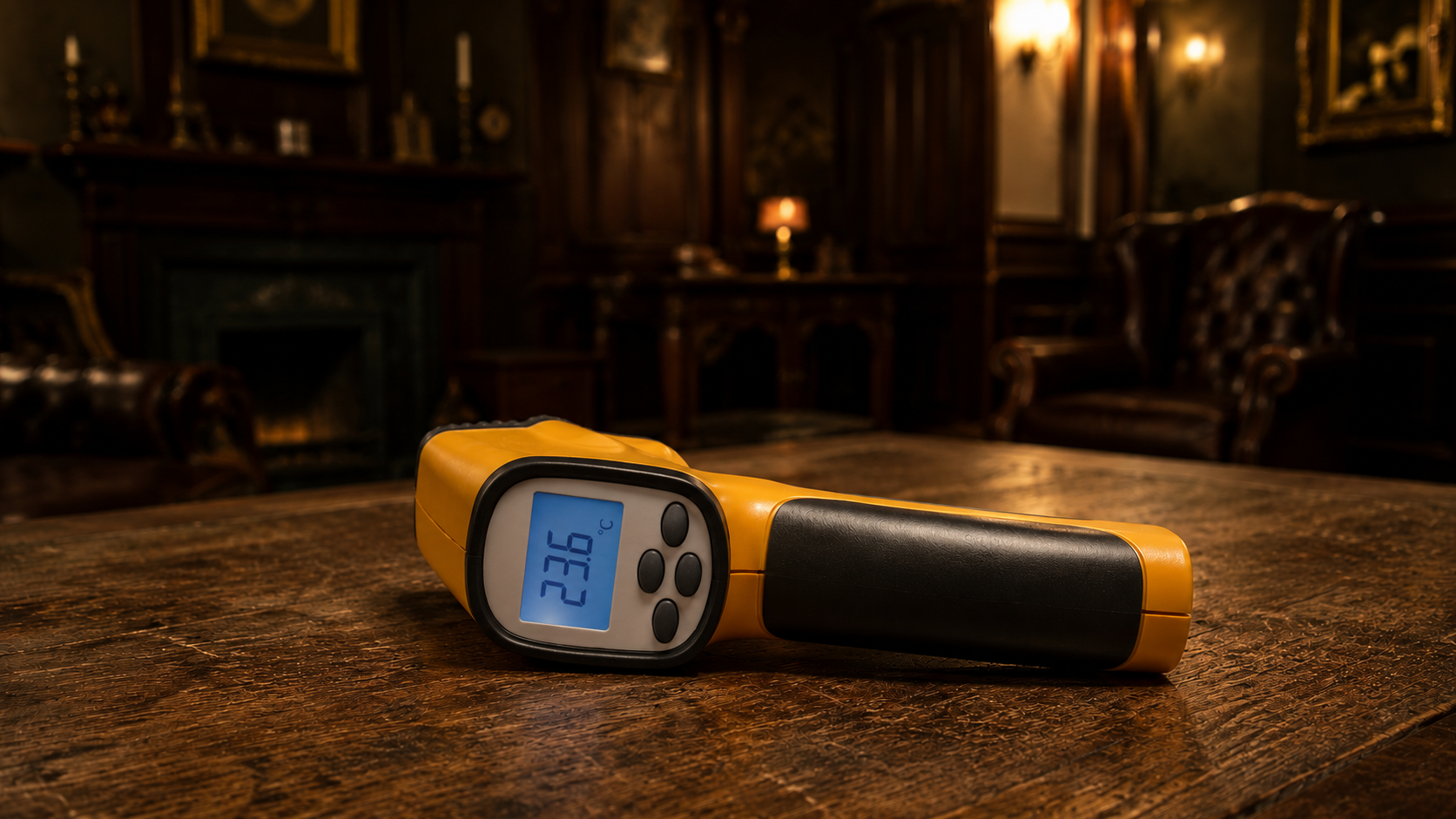
If you have attended a paranormal investigation, you may have seen investigators carrying a small handheld device shaped like a gun and pointing it towards walls, floors, furniture or other surfaces. This is an infrared thermometer, sometimes called an infrared thermometer gun, laser thermometer or non-contact thermometer.
Infrared thermometers are commonly used during paranormal investigations to take quick temperature readings without touching the surface being measured. Investigators may use them when examining reports of unexplained cold areas, sudden temperature changes or unusual environmental conditions.
Although these devices are simple to use, their readings are often misunderstood. An infrared thermometer measures the surface temperature of an object or area. It does not directly measure the temperature of the air where the laser dot appears, and it does not detect ghosts or spirits.
This guide explains what an infrared thermometer is, how it works, how paranormal investigators use one and why temperature readings should always be considered alongside the surrounding environment.
What Is an Infrared Thermometer?
An infrared thermometer is a handheld electronic device that measures surface temperature without requiring physical contact.
Every object with a temperature above absolute zero emits infrared energy. An infrared thermometer detects some of this energy and uses it to estimate the temperature of the surface towards which it is pointed.
Most handheld infrared thermometers have:
- A pistol-style handle
- A trigger used to take a reading
- An infrared sensor
- A digital display
- A laser aiming guide
- Controls for changing settings or measurement units
Infrared thermometers are used in many ordinary settings, including building maintenance, electrical inspections, heating systems, food preparation and vehicle diagnostics.
During paranormal investigations, they provide a quick way to compare the temperatures of surfaces throughout a location and document changes that may require further investigation.
Importantly, an infrared thermometer is an environmental measuring instrument. It does not identify what caused a temperature reading and cannot determine whether an experience is paranormal.
How Does an Infrared Thermometer Work?
When the trigger is pressed, the infrared thermometer detects infrared energy emitted by the surface within its measurement area.
The device converts this information into a temperature reading, which is displayed on the screen.
The reading may appear almost instantly, making infrared thermometers useful for quickly checking different surfaces around a room.
However, the device does not measure only the small point shown by the laser. As the distance between the thermometer and the surface increases, the area being measured also becomes larger.
This means a reading taken from farther away may include several different materials or temperatures within the same measurement area.
For example, if an investigator aims at a small cold patch on a wall from across a large room, the thermometer may also measure part of the warmer wall surrounding it. Moving closer may provide a more useful reading.
What Does the Laser Measure?
The laser does not measure temperature.
It is simply an aiming guide that helps show approximately where the infrared thermometer is pointing.
The actual temperature measurement is taken by the infrared sensor, which measures an area rather than a single laser-sized point.
This is an important distinction because it is easy to assume that the temperature shown on the display comes only from the exact location of the laser dot.
The size of the measurement area depends on the distance-to-spot ratio of the thermometer. Different models may have different ratios, so investigators should read the instructions supplied with their device.
The farther away the thermometer is from a surface, the larger the area included in the reading.
Does an Infrared Thermometer Measure Air Temperature?
A handheld infrared thermometer does not directly measure air temperature.
Infrared thermometers are designed to measure the temperature of surfaces. When an investigator points one into an apparently empty area of a room, the device is generally measuring the surface behind that area, such as a wall, floor, ceiling, door or piece of furniture.
The laser may appear to travel through the air, but the device is not measuring the temperature at the point where the beam passes.
This is one of the most common misunderstandings surrounding infrared thermometers during paranormal investigations.
If investigators want to measure changes in ambient air temperature, they should use equipment designed for that purpose, such as a digital thermometer with an air-temperature sensor or a suitable environmental data logger.
Infrared and air-temperature measurements can both be useful, but they measure different things and should not be treated as interchangeable.
Why Do Paranormal Investigators Use Infrared Thermometers?
Reports of unusual experiences sometimes include descriptions of sudden cold sensations, unexplained warm areas or noticeable changes in temperature.
Investigators may use infrared thermometers to examine the surrounding environment and determine whether measurable surface-temperature differences are present.
An infrared thermometer may help investigators:
- Compare surface temperatures in different areas
- Check walls, floors, doors and furniture
- Investigate reported cold or warm areas
- Identify possible draughts or areas affected by outside conditions
- Locate surfaces influenced by heating systems
- Compare readings before, during and after an experiment
- Record environmental information alongside other observations
- Identify changes that may require further investigation
Because readings can be taken quickly, investigators can compare several surfaces without moving equipment between each location.
However, a temperature difference should be treated as an observation rather than a conclusion. Further checks are needed before deciding whether a reading is unusual.
How Are Infrared Thermometers Used During Paranormal Investigations?
Before beginning an investigation, it can be useful to take baseline readings from several surfaces around the area.
These may include:
- Interior walls
- External walls
- Floors
- Ceilings
- Doors
- Windows
- Furniture
- Areas near radiators or fireplaces
Taking baseline readings provides something against which later measurements can be compared.
If a guest reports feeling a cold area, an investigator may use the infrared thermometer to check nearby surfaces. The reading can then be compared with surrounding areas and repeated to see whether the difference remains.
Investigators should record useful details such as:
- The time of the reading
- The temperature displayed
- The surface being measured
- The approximate distance from the surface
- The location within the building
- Previous readings from the same area
- Whether heating was operating
- Whether doors or windows were open
- Whether anyone had recently entered or left
- Any other observations made at the same time
A single reading provides limited information. Repeated measurements and accurate notes provide more useful context.
What Can Affect an Infrared Thermometer Reading?
Many ordinary environmental factors can influence surface temperature.
Possible explanations for an unusual reading include:
- External walls being colder than internal walls
- Open doors or windows
- Draughts
- Poor insulation
- Damp walls
- Heating pipes
- Radiators
- Fireplaces
- Electrical equipment
- Direct sunlight
- Recently occupied furniture
- Different building materials
- Cold floors or stonework
- Air-conditioning systems
Historic buildings can contain thick stone walls, uneven insulation, old windows and areas with very different temperatures.
A colder surface is therefore not automatically unexplained. Investigators should consider the construction and condition of the building before drawing conclusions.
Can Reflective Surfaces Affect the Reading?
Shiny or reflective surfaces can make infrared temperature readings less reliable.
Materials such as polished metal, mirrors, glass and some glossy finishes may reflect infrared energy from surrounding objects rather than providing a straightforward measurement of their own surface temperature.
This can produce readings that appear unusual or inconsistent.
Infrared thermometers may also have difficulty measuring through glass. Pointing the device towards an object on the other side of a window will generally provide information relating to the glass surface rather than the distant object.
If a reading appears unusual, investigators should repeat the measurement from a similar distance and angle before comparing it with nearby non-reflective surfaces.
How Should an Infrared Thermometer Be Used Correctly?
Correct use helps make temperature readings more consistent and easier to compare.
Before using an infrared thermometer:
- Check that the batteries have sufficient charge
- Confirm that the device is set to degrees Celsius
- Allow the thermometer to adjust if it has been moved between very different temperatures
- Check the manufacturer’s recommended operating range
- Understand the distance-to-spot ratio of the device
When taking a reading:
- Aim at a clear surface rather than empty space
- Keep a suitable distance from the target
- Avoid measuring an area smaller than the thermometer’s measurement spot
- Take readings from a consistent distance
- Avoid changing the angle unnecessarily
- Repeat unexpected readings
- Compare the result with nearby surfaces
- Record the location and environmental conditions
Investigators should avoid relying on a single measurement. If a reading appears unusual, it should be checked again and compared with the surrounding area.
Common Mistakes When Using Infrared Thermometers
Pointing the Thermometer into Empty Space
An infrared thermometer does not measure the temperature of the air around the laser beam. It measures the surface within its field of view.
Assuming the Laser Measures Temperature
The laser is an aiming guide. The infrared sensor performs the measurement.
Taking Readings from Too Far Away
As distance increases, the measured area becomes larger. A distant reading may include several surfaces or temperature zones.
Comparing Different Materials
Wood, stone, metal, glass and fabric can behave differently. A temperature difference between materials does not necessarily indicate an unexplained change.
Treating One Reading as Evidence
A single temperature reading provides very little context. Unexpected results should be repeated, compared and documented.
Ignoring the Environment
Open windows, heating systems, damp, sunlight and building construction can all influence surface temperatures.
Common Misconceptions
“The Laser Measures the Temperature”
No. The laser only helps indicate where the thermometer is aimed. The infrared sensor measures energy emitted or reflected by the surface within a wider measurement area.
“It Measures a Cold Spot in the Air”
Not directly. A handheld infrared thermometer measures surface temperature rather than ambient air temperature.
“A Sudden Temperature Drop Means Something Paranormal Is Present”
No. Temperature differences can have many natural causes and require further investigation.
“The Laser Dot Is the Entire Measurement Area”
No. The measurement area is usually larger than the visible laser dot and increases as the distance from the surface increases.
“Every Surface Produces an Equally Accurate Reading”
No. Reflective materials, glass and different surface finishes can affect infrared measurements.
Frequently Asked Questions
Are Infrared Thermometers Safe?
Yes. Handheld infrared thermometers are commonly used measuring instruments.
However, the laser should never be aimed into anyone’s eyes. Investigators should follow the safety information supplied with their device.
Can Beginners Use an Infrared Thermometer?
Yes. Infrared thermometers are straightforward to operate, although understanding what they measure is important when interpreting the results.
Does an Infrared Thermometer Detect Ghosts?
No. It measures surface temperature and cannot identify ghosts, spirits or paranormal activity.
Can an Infrared Thermometer Measure a Cold Spot?
It can identify a colder surface, but it does not directly measure a cold area in the air.
Why Do Investigators Point Them at Walls and Floors?
Walls and floors provide surfaces that can be measured and compared. Investigators may check whether a reported cold area corresponds with a measurable surface-temperature difference.
Can I Use an Infrared Thermometer Through Glass?
Infrared thermometers generally measure the surface of the glass rather than the temperature of an object behind it.
Is a More Expensive Infrared Thermometer Better for Paranormal Investigations?
Not necessarily. Understanding the device, using it consistently and interpreting readings carefully are often more important than purchasing an expensive model.
Do I Need My Own Infrared Thermometer?
No. Organised paranormal investigation events will often provide the equipment required during the investigation.
Conclusion
Infrared thermometer guns are popular during paranormal investigations because they provide a quick and simple way to compare surface temperatures without physical contact.
They can help investigators examine reported cold or warm areas, identify environmental differences and record additional information about a location.
However, understanding their limitations is essential. An infrared thermometer measures surface temperature rather than air temperature, the laser is only an aiming guide and many ordinary environmental factors can influence a reading.
An unexpected temperature should therefore be checked, repeated, compared with nearby surfaces and documented alongside the surrounding conditions.
An infrared thermometer can provide useful environmental information, but a temperature reading alone does not prove paranormal activity.
Continue Learning
You may also find these Knowledge Base guides useful:
- What Is an EMF Meter? — Learn how electromagnetic fields are measured during paranormal investigations.
- What Is a Motion Sensor? — Discover how motion sensors work and what may cause them to activate.
- What Is a REM Pod? — Learn how a REM Pod monitors changes around its antenna.
- Common Ghost Hunting Equipment Explained — Explore the equipment commonly used during paranormal investigations.