Introduction
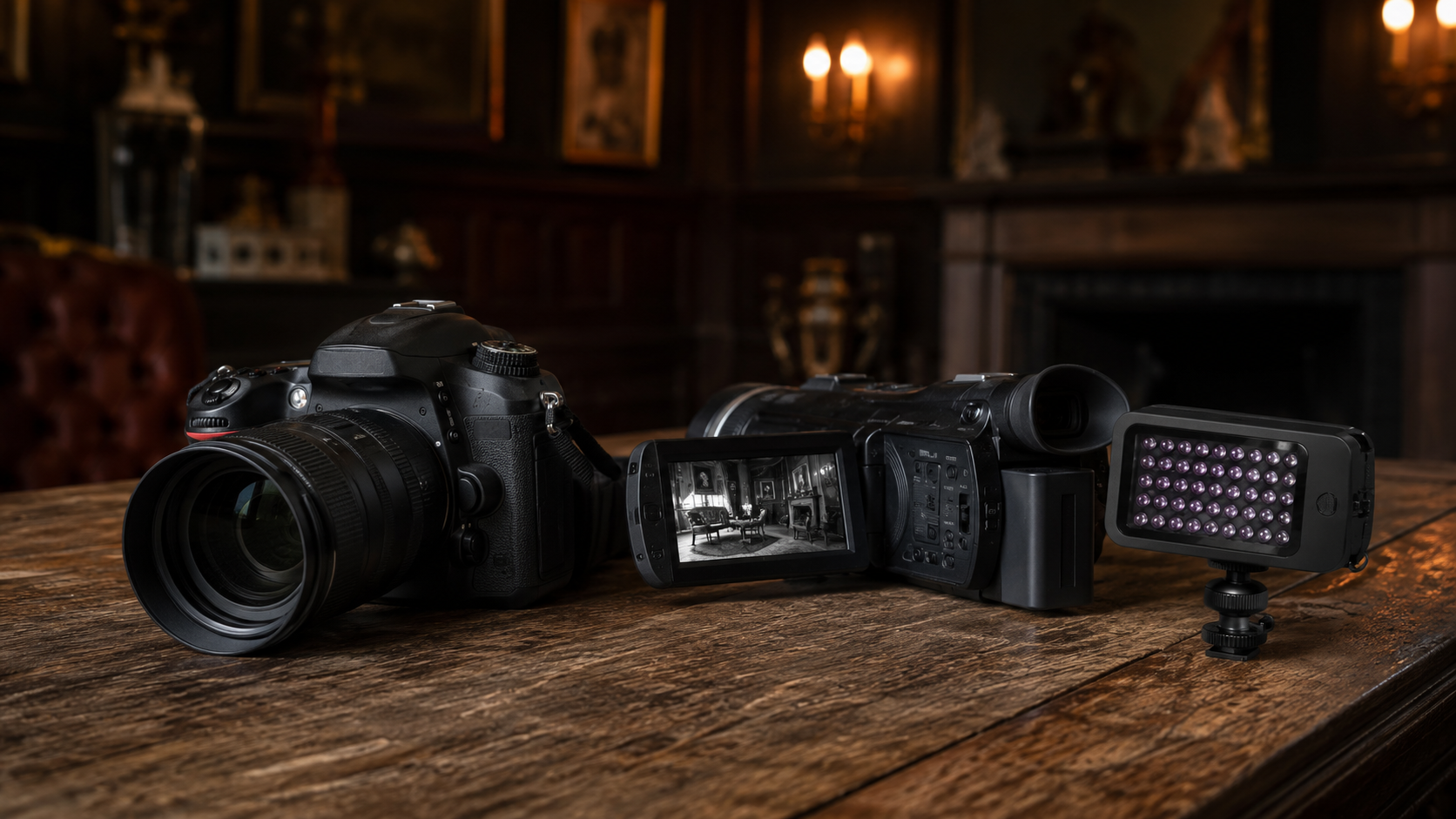
If you have watched a paranormal investigation, you may have seen investigators using a digital camera or camcorder fitted with an infrared light. The resulting photographs or video may appear pale, monochrome, purple-tinted or very different from an ordinary low-light image.
This equipment is often described as a full-spectrum camera.
Full-spectrum cameras are used during paranormal investigations because they can record a wider range of light than most standard consumer cameras. They may capture visible light alongside parts of the near-infrared and ultraviolet spectrum, depending on the camera, its conversion and the lighting being used.
However, the term full spectrum is often misunderstood. It does not mean that the camera can capture every wavelength in the electromagnetic spectrum, and it does not allow investigators to photograph ghosts that would otherwise be invisible.
This guide explains what a full-spectrum camera is, how cameras and camcorders are converted, why paranormal investigators use them and why unusual images should always be reviewed carefully before conclusions are drawn.
What Is a Full-Spectrum Camera?
A full-spectrum camera is usually an ordinary digital camera or camcorder that has been modified so its image sensor can detect a wider range of light than it could originally.
Standard consumer cameras normally contain an internal filter designed to block most ultraviolet and infrared light. This helps the camera create photographs that resemble the colours seen by the human eye.
During a full-spectrum conversion, this internal filter is removed or replaced. The camera may then become sensitive to:
- Visible light
- Some near-infrared light
- Some ultraviolet light
The exact range depends on:
- The camera sensor
- The conversion carried out
- The lens
- Any external filters fitted
- The available light source
A full-spectrum camera is therefore better described as a wider-spectrum imaging device rather than a camera that records the complete electromagnetic spectrum.
Full-Spectrum Cameras and Camcorders
Full-spectrum equipment may include both still cameras and video cameras.
Full-Spectrum Still Cameras
A modified digital still camera may be used to take individual photographs during an investigation.
These cameras can be useful for:
- Photographing rooms and objects
- Recording the original position of equipment
- Taking comparison photographs
- Documenting reported visual experiences
- Capturing images under infrared illumination
Many modern digital cameras can also record video, so they may serve both purposes.
Full-Spectrum Camcorders
A modified camcorder is designed primarily for continuous video recording.
Investigators may use one to:
- Monitor a room during a vigil
- Record an investigation session
- Observe equipment over a longer period
- Review movement or light changes later
- Capture video in very low visible light when used with an infrared illuminator
Some camcorders are easier to leave recording on a tripod for long periods, while still cameras may offer better photographic quality.
For the purposes of this article, the term full-spectrum camera includes both modified still cameras and camcorders unless a distinction is important.
How Is a Camera Converted to Full Spectrum?
A standard digital camera usually has a filter placed in front of its sensor. This is often called an infrared-cut filter, hot mirror or UV/IR blocking filter.
Its purpose is to reduce wavelengths of light that could distort normal photographs.
During a full-spectrum conversion, a technician may:
- Open the camera body.
- Remove the original UV and infrared blocking filter.
- Replace it with clear optical glass or another suitable filter.
- Reassemble and recalibrate the camera.
Once converted, the sensor can receive a wider range of wavelengths.
This is a delicate process. Opening a camera may damage the sensor, affect focus or introduce dust if it is not completed correctly.
For that reason, conversions are often carried out by specialist technicians rather than attempted at home.
Does Full Spectrum Mean Every Type of Light?
No.
The phrase full spectrum can sound as though the camera records every form of electromagnetic radiation. It does not.
A converted consumer camera usually remains limited to a relatively narrow region surrounding visible light. It may detect:
- Some ultraviolet light
- Visible light
- Some near-infrared light
It cannot normally detect:
- Radio waves
- Microwaves
- X-rays
- Gamma rays
- Far-infrared thermal radiation in the same way as a thermal camera
The term is widely used in photography and paranormal investigation, but it should not be interpreted literally.
The camera’s actual sensitivity depends heavily on the sensor and lens.
Why Do Standard Cameras Block Infrared and Ultraviolet Light?
Digital image sensors are often naturally sensitive to wavelengths beyond normal human vision.
Without a blocking filter, infrared light can affect colour accuracy, contrast and focus.
Camera manufacturers therefore add filters so photographs look more natural.
Removing that filter allows the sensor to record additional wavelengths, but it also means:
- Colours may appear unusual
- Images may require specialist lighting
- Focus can behave differently
- Different lenses may produce different results
- Photographs may not resemble what investigators saw with their eyes
These differences are a normal consequence of the conversion rather than evidence of paranormal activity.
Why Do Paranormal Investigators Use Full-Spectrum Cameras?
Paranormal investigators may use full-spectrum cameras to document a location under lighting conditions that differ from normal visible-light photography.
They may be used to:
- Record investigations in darkness
- Capture video using infrared illumination
- Monitor rooms without bright visible lighting
- Photograph equipment setups
- Document visual reports
- Compare ordinary and infrared images
- Record vigils or experiments for later review
- Observe areas over extended periods
Infrared illumination is particularly useful because it can allow a compatible camera to record a scene that appears dark to the human eye.
This can help investigators monitor the room without using bright white lights that might disrupt the atmosphere of the investigation.
However, recording a wider range of light does not mean the camera can identify paranormal activity.
What Is an Infrared Illuminator?
An infrared illuminator is a light source that emits near-infrared light.
Although the room may appear dark to investigators, a compatible camera may use this infrared light to create a visible image.
Infrared illuminators may be:
- Mounted on top of a camera
- Positioned separately in a room
- Built into some camcorders
- Powered by batteries or an external power source
Their effective range varies.
A small camera-mounted illuminator may work well in a compact room but may not provide enough coverage for a large hall or long corridor.
Using too much infrared light can also create problems such as:
- Overexposed nearby objects
- Bright reflections
- Washed-out faces or surfaces
- Strong shadows
- Dust and insects becoming highly visible
Investigators should test the lighting before relying on it during a session.
What Is Ultraviolet Lighting?
Some full-spectrum photographers also use ultraviolet lighting.
Ultraviolet light falls just beyond the violet end of the visible spectrum.
However, ultraviolet photography can be more complicated than infrared photography because:
- Many lenses block much of the ultraviolet light
- Camera sensors vary in ultraviolet sensitivity
- Dedicated UV lighting may be required
- Reflections and fluorescence can affect images
- Some UV lights may pose eye or skin risks if used incorrectly
For most paranormal investigations, infrared lighting is more commonly used than ultraviolet lighting.
Any ultraviolet equipment should be used according to the manufacturer’s safety guidance.
What Does a Full-Spectrum Image Look Like?
The appearance of a full-spectrum photograph depends on the camera, lighting and filters used.
Images may appear:
- Pale
- Purple or magenta
- Red-tinted
- Blue-tinted
- Monochrome
- High in contrast
- Washed out
- Different from the scene seen by the human eye
If infrared lighting is used in darkness, the result may resemble black-and-white night-vision footage.
Colour differences are not automatically unusual. They are often caused by the camera recording wavelengths that a standard camera would normally block.
White balance settings can also significantly change the appearance of the image.
Is a Full-Spectrum Camera the Same as a Night-Vision Camera?
Not exactly.
A night-vision camera is designed to record in low-light or dark conditions, often using infrared illumination.
A full-spectrum camera has been modified to detect a wider range of wavelengths.
A full-spectrum camera may function as a night-vision camera when paired with infrared lighting, but the two terms do not mean precisely the same thing.
Some ordinary security cameras can record infrared night vision without being described as full spectrum.
Similarly, a full-spectrum still camera can be used in daylight with suitable filters rather than only at night.
Is a Full-Spectrum Camera the Same as a Thermal Camera?
No.
These devices are often confused, but they work differently.
Full-Spectrum Camera
A full-spectrum camera records light, including visible light and potentially some near-infrared and ultraviolet wavelengths.
It produces an image based on reflected or emitted light reaching the sensor.
Thermal Imaging Camera
A thermal camera detects longer-wave infrared radiation associated with surface temperature.
It produces a thermal image representing relative temperature differences.
A full-spectrum camera does not show heat patterns in the same way as a thermal camera.
Likewise, a thermal camera does not produce an ordinary infrared night-vision image.
Can a Full-Spectrum Camera See in Complete Darkness?
Not without a suitable light source.
A full-spectrum camera still needs light to form an image.
If there is no visible, infrared or ultraviolet light reaching the sensor, the camera cannot record useful detail.
During dark investigations, an infrared illuminator may provide the light needed.
This is similar to using an ordinary torch with a standard camera, except the infrared illumination may not be clearly visible to the human eye.
The camera is not seeing without light; it is using light outside the range normally visible to people.
What Can Cause Unusual Full-Spectrum Images?
Full-spectrum cameras can capture many ordinary effects that may initially appear unusual.
Dust
Dust close to the lens can reflect infrared light and appear as bright circular shapes.
These are often described as orbs, but they are usually out-of-focus particles near the camera.
Insects
Small insects may appear bright, blurred, stretched or strangely shaped when illuminated by infrared light.
Their movement can create trails or unusual forms.
Moisture
Rain, condensation, breath and airborne moisture may reflect light and create bright patches or circles.
Lens Flare
Strong lights can reflect within the lens and produce shapes, streaks or coloured spots.
Reflections
Mirrors, windows, polished surfaces and metal may reflect infrared light differently from visible light.
Motion Blur
A slow shutter speed may cause moving people or objects to appear transparent, stretched or blurred.
Digital Noise
Low-light recording often requires high sensor sensitivity, which can introduce grain, coloured speckles or blocky artefacts.
Compression
Video compression can create smearing, pixelation and false detail, particularly in dark scenes.
Infrared Shadows
An infrared illuminator may cast shadows from a different direction than visible room lighting, creating shapes that investigators did not notice at the time.
Why Do Dust and Insects Look So Bright?
Infrared illuminators are often positioned very close to the camera lens.
When dust or an insect passes near the lens, it can reflect a large amount of infrared light directly back into the camera.
Because the object is too close for the lens to focus on properly, it may appear as:
- A bright circle
- A soft orb
- A glowing line
- A blurred rod
- An irregular translucent shape
This effect is common in low-light photography and does not require a paranormal explanation.
Changing the camera angle, moving the illuminator away from the lens or comparing multiple frames may help identify the cause.
Can Full-Spectrum Cameras Photograph Ghosts?
There is no scientific evidence that full-spectrum cameras can photograph ghosts or spirits.
The camera records light reaching its sensor.
It cannot identify the source of an unusual shape or determine whether it is paranormal.
Some investigators believe that recording beyond visible light may capture phenomena that people cannot see directly. However, this remains an unproven interpretation.
Any unusual photograph or video should first be examined for:
- Dust
- Insects
- Reflections
- Lens flare
- Movement
- Other people
- Camera straps
- Hair or clothing
- Moisture
- Compression artefacts
- Lighting changes
- Equipment faults
If no clear explanation is found, the image may remain unexplained. That is not the same as proving it shows a ghost.
How Should a Full-Spectrum Camera Be Used During an Investigation?
Before recording, investigators should become familiar with the camera and its lighting.
Useful preparation includes:
- Charging all batteries
- Formatting or checking memory cards
- Cleaning the lens
- Setting the correct date and time
- Testing the infrared illuminator
- Checking focus
- Confirming the recording mode
- Taking comparison photographs
- Recording the camera’s location
- Making sure the equipment is secure
During an investigation, it is helpful to:
- Keep the camera position stable
- Avoid constantly moving the illuminator
- Announce when people enter the recording area
- Record known environmental noises
- Avoid touching the lens
- Note changes in lighting
- Preserve the original files
- Review unusual events frame by frame
A static camera on a tripod often provides more reliable context than handheld footage moving constantly through a dark room.
Why Is a Baseline Recording Important?
A baseline recording shows how the room normally appears through the camera.
Before an experiment begins, investigators may record:
- The empty room
- Doors and windows
- Reflective surfaces
- Existing lights
- Heating equipment
- Curtains and hanging objects
- Equipment positions
- Common walking routes
This can make later footage easier to interpret.
For example, a bright reflection may initially appear unusual. Baseline footage may reveal that it occurs every time the camera points towards a particular window.
Without comparison footage, ordinary effects can be much harder to recognise.
Should the Camera Be Handheld or Mounted?
Both approaches can be useful.
Handheld Use
Handheld cameras allow investigators to move through a location and document different areas.
However, handheld footage may introduce:
- Camera shake
- Motion blur
- Rapid exposure changes
- Unclear reflections
- Accidental obstruction of the lens
Tripod or Static Use
A camera mounted on a tripod provides a stable view of one area.
This can make it easier to:
- Compare movement
- Monitor equipment
- Review a fixed location
- Identify people entering the frame
- Observe changes over time
For evidence review, stable footage generally provides more context.
Common Mistakes When Using Full-Spectrum Cameras
Assuming Full Spectrum Means Every Wavelength
The camera only records the wavelengths its sensor, conversion and lens can detect.
Recording Without an Infrared Light
In complete darkness, the camera still requires a suitable source of illumination.
Placing the Illuminator Too Close to the Lens
This can make dust and insects appear extremely bright.
Ignoring Reflective Surfaces
Glass, mirrors and polished objects can create confusing reflections.
Using Automatic Focus in Complete Darkness
The camera may struggle to focus if there is insufficient contrast.
Changing Settings During a Session
Unrecorded changes to exposure, white balance or lighting may later be mistaken for environmental changes.
Reviewing Screenshots Instead of Original Files
Compressed screenshots may hide useful detail or introduce new artefacts.
Assuming an Unusual Shape Is Paranormal
Every ordinary photographic and environmental explanation should be considered first.
Common Misconceptions
“Full-Spectrum Cameras Can See Spirits”
There is no evidence that these cameras can identify or reveal spirits.
“They Can Record Every Type of Energy”
No. They usually record a wider range of light around the visible spectrum.
“They Work in Total Darkness Without Lighting”
No. A suitable infrared or other light source is needed.
“Anything Invisible to the Eye Must Be Paranormal”
Infrared light, dust, insects and reflections may all be invisible or difficult to see directly while still being completely ordinary.
“Full-Spectrum and Thermal Cameras Are the Same”
No. Full-spectrum cameras record light, while thermal cameras display surface-temperature differences.
“Purple or White Areas Show Paranormal Energy”
Unusual colours are often caused by white balance, lighting, sensor sensitivity or the conversion itself.
Frequently Asked Questions
Are Full-Spectrum Cameras Safe?
Yes. The camera itself is a passive recording device.
Infrared illuminators are generally safe when used correctly. Ultraviolet lights require more care and should be used according to their safety instructions.
Can Beginners Use a Full-Spectrum Camera?
Yes, although beginners should spend time learning how the camera responds to infrared light, dust, reflections and low-light conditions.
Can a Normal Camera Be Used for Paranormal Investigations?
Yes. A standard digital camera can still document rooms, equipment positions and investigation activity.
A full-spectrum conversion is not required to conduct a responsible investigation.
Can a Smartphone Be Full Spectrum?
Most smartphones contain filters that limit infrared and ultraviolet sensitivity.
Some may detect small amounts of infrared from remote controls, but they are not normally equivalent to a properly converted full-spectrum camera.
Do Full-Spectrum Cameras Record Sound?
Camcorders and video-capable cameras may record sound if they contain a microphone.
Audio quality varies, and a separate digital voice recorder may provide clearer results.
Can Full-Spectrum Cameras See Through Walls?
No. They record light reflected or emitted from visible surfaces and cannot see through solid walls.
Can They See Through Clothing?
Ordinary converted paranormal investigation cameras should not be treated as devices that see through clothing. Claims of this kind are misleading and inappropriate.
Why Do Eyes Sometimes Look Bright on Infrared Video?
Infrared light can reflect from the eyes of people and animals, creating a bright appearance similar to red-eye in flash photography.
Are Expensive Full-Spectrum Cameras Better?
Higher-quality cameras may offer improved resolution, low-light performance and controls. However, careful use and accurate interpretation matter more than price alone.
Do I Need My Own Full-Spectrum Camera?
No. Many organised paranormal investigation events provide suitable equipment for guests where required.
Conclusion
Full-spectrum cameras and camcorders are modified imaging devices that can record a wider range of light than most standard consumer cameras.
When paired with infrared illumination, they can be useful for documenting investigations in darkness, monitoring rooms and reviewing events later.
However, the term full spectrum does not mean that the camera records every wavelength or detects paranormal energy. The equipment remains limited by its sensor, lens, conversion and lighting.
Dust, insects, reflections, moisture, motion blur, digital noise and infrared lighting can all create unusual-looking images.
For that reason, photographs and video should be reviewed carefully and compared with baseline recordings, environmental conditions and other available evidence.
A full-spectrum camera can be a useful documentation tool, but an unusual image alone does not prove paranormal activity.
Continue Learning
You may also find these Knowledge Base guides useful:
- What Is a Thermal Imaging Camera? — Learn how thermal cameras display surface-temperature differences.
- What Is an Infrared Thermometer? — Understand how infrared thermometer guns measure surface temperatures.
- What Is a Digital Voice Recorder? — Discover how investigators document and review audio.
- Common Ghost Hunting Equipment Explained — Explore the tools commonly used during paranormal investigations.