Introduction
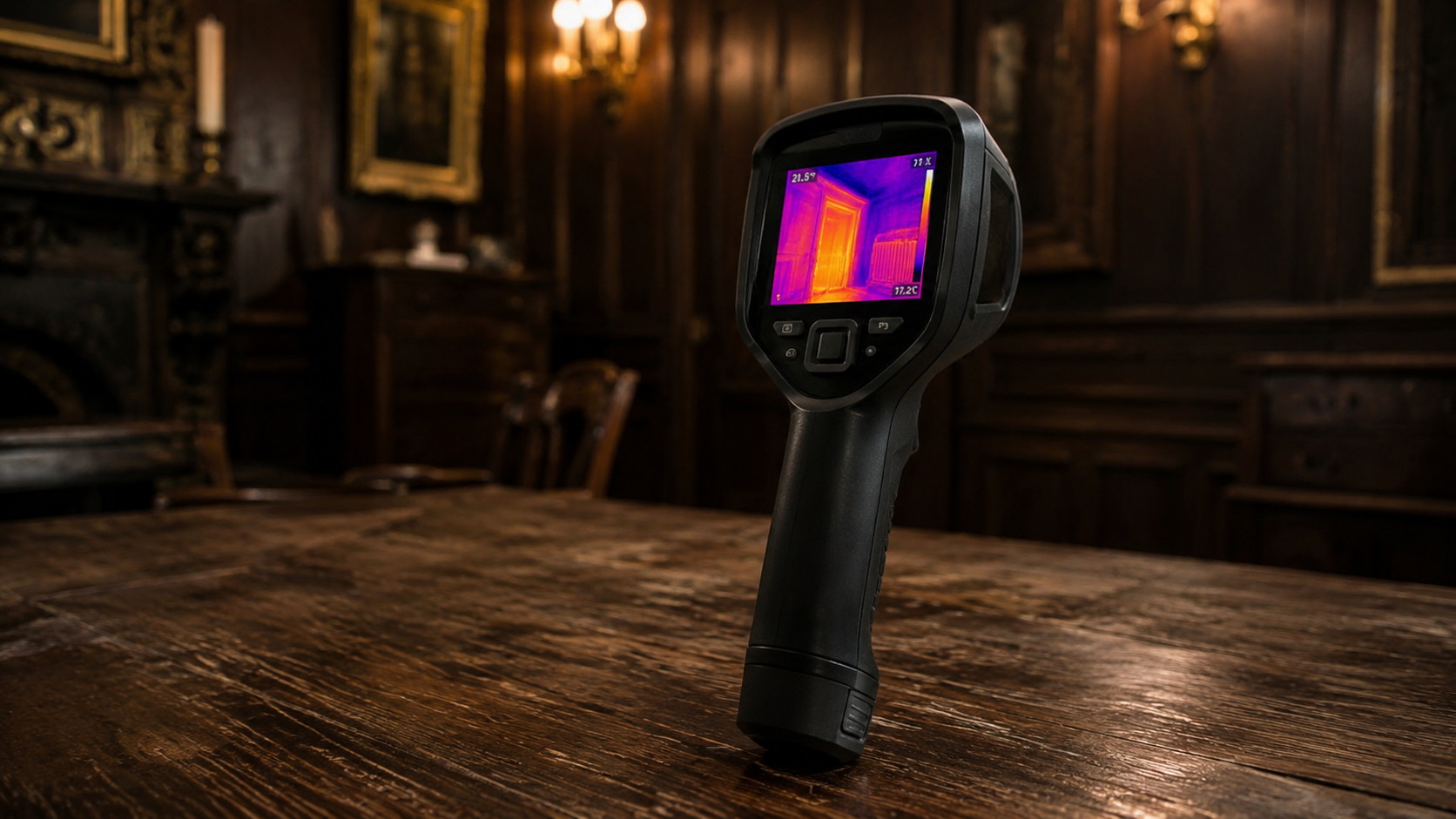
If you have watched a paranormal investigation, you may have seen investigators using a handheld camera that displays rooms and objects in bright colours such as red, yellow, blue and purple. This is known as a thermal imaging camera, sometimes shortened to thermal camera.
Thermal imaging cameras are used in many professional industries to help identify differences in surface temperature. During paranormal investigations, they may be used to examine reported cold or warm areas, observe environmental changes and document temperature patterns that may not be immediately obvious.
The colourful display can make thermal imaging appear mysterious or difficult to understand. However, the colours do not show ghosts, spirits or paranormal energy. They are a visual representation of differences in detected infrared radiation.
This guide explains what a thermal imaging camera is, how it works, why paranormal investigators use one and why unusual thermal images require careful investigation before conclusions are drawn.
What Is a Thermal Imaging Camera?
A thermal imaging camera is an electronic device that detects infrared radiation emitted by surfaces and converts the information into a visible image.
Unlike an ordinary camera, which records visible light, a thermal camera creates an image based mainly on detected differences in surface temperature.
Warmer and cooler areas are represented using different colours or shades. This allows the user to compare temperature patterns across a larger scene rather than checking one area at a time.
Thermal imaging cameras are commonly used for:
- Building inspections
- Electrical maintenance
- Heating and ventilation checks
- Detecting areas of heat loss
- Locating overheating equipment
- Fire and rescue work
- Industrial inspections
- Wildlife observation
During paranormal investigations, thermal cameras are used as environmental measuring tools. They can help investigators observe and document temperature differences, but they cannot identify what caused those differences.
A thermal imaging camera does not detect ghosts or spirits.
How Does a Thermal Imaging Camera Work?
All objects with a temperature above absolute zero emit infrared radiation.
A thermal imaging camera contains a specialised sensor that detects infrared radiation from the surfaces within its field of view.
The camera processes this information and creates a thermal image, sometimes called a thermogram.
Different temperatures are then represented using colours or shades on the display.
The camera may also show:
- An estimated temperature reading
- A central measurement point
- The warmest area in the image
- The coolest area in the image
- A temperature scale
- Different colour-palette options
The thermal image allows investigators to compare temperature patterns across walls, floors, doors, furniture and other visible surfaces.
However, the camera does not explain why an area appears warmer or cooler. The cause must be investigated separately.
What Do the Colours on a Thermal Camera Mean?
The colours on a thermal image represent relative differences in detected temperature.
Many thermal cameras use a colour palette in which:
- White and yellow represent warmer areas
- Orange and red represent relatively warm areas
- Purple and blue represent cooler areas
However, the exact colours depend on the selected display palette and temperature range.
Some thermal cameras use entirely different colour schemes, while others display thermal information in shades of grey.
The colours should not be interpreted as fixed temperatures. A blue area is not automatically extremely cold, and a red area is not necessarily dangerously hot.
The camera automatically adjusts its display according to the warmest and coolest areas currently visible. This means the colours may change when the camera is moved, even if the actual temperature of an object has remained the same.
Investigators should therefore look at the displayed temperature scale and measurements rather than judging a thermal image only by its colours.
Why Do Paranormal Investigators Use Thermal Imaging Cameras?
Reports of unusual experiences sometimes include descriptions of cold sensations, unexplained warmth, moving shadows or changes in the surrounding environment.
A thermal imaging camera may help investigators examine whether visible surface-temperature differences are present.
Thermal cameras may help investigators:
- Compare temperature patterns across a room
- Examine reported cold or warm areas
- Observe walls, floors, ceilings and furniture
- Identify possible draughts or heat loss
- Locate heating pipes behind surfaces
- Detect residual heat left by people or equipment
- Monitor selected areas during experiments
- Record thermal images for later review
- Compare environmental conditions over time
Unlike a handheld infrared thermometer, which provides a temperature estimate for a particular measurement area, a thermal camera displays temperature differences across a wider scene.
This can make patterns easier to identify, but the images still require careful interpretation.
An unusual thermal pattern should be treated as an observation rather than evidence of paranormal activity.
What Is the Difference Between a Thermal Camera and an Infrared Thermometer?
Thermal imaging cameras and infrared thermometers both detect infrared radiation, but they present the information differently.
An infrared thermometer usually provides a numerical temperature estimate for a measured surface area.
A thermal imaging camera creates an image containing many temperature measurements across a wider field of view.
This allows the user to see patterns and compare warmer and cooler areas at the same time.
For example, an infrared thermometer may show that part of a wall has a surface temperature of 12°C. A thermal camera may show how that cooler area is distributed across the wall and how it compares with the surrounding surfaces.
Both devices measure surface temperatures rather than directly measuring the temperature of the air.
Neither device can determine whether a temperature difference is paranormal.
How Are Thermal Imaging Cameras Used During Paranormal Investigations?
Before using a thermal imaging camera, investigators may scan an area to identify ordinary temperature patterns and establish baseline conditions.
These may include:
- Colder external walls
- Warmer internal walls
- Windows and doors
- Radiators
- Heating pipes
- Fireplaces
- Electrical equipment
- Areas affected by sunlight
- Recently occupied furniture
Understanding these existing patterns can make later observations easier to interpret.
During an investigation, the camera may be used to examine a reported cold or warm area or to monitor a room during an experiment.
If an unusual pattern appears, investigators should consider:
- Where the pattern appeared
- Whether it remained stationary or moved
- How long it was visible
- Whether anyone had recently touched the area
- Whether someone had been sitting or standing nearby
- Whether heating or electrical equipment was present
- Whether doors or windows were open
- Whether the pattern appeared from more than one angle
- Whether it could be repeated
Whenever possible, unusual observations should be documented with the time, location and surrounding conditions.
A thermal image without context may be difficult to interpret later.
What Can Affect a Thermal Image?
Many ordinary factors can create noticeable patterns on a thermal camera.
These may include:
- Radiators
- Heating pipes
- Electrical equipment
- Lights
- Open windows
- Draughts
- Poor insulation
- Damp walls
- Sunlight
- External walls
- Different building materials
- Recently opened doors
- Warm furniture
- Human body heat
- Footprints
- Handprints
- Recently moved objects
Historic buildings often contain thick stone walls, old windows, uneven insulation and heating systems that create significant temperature differences.
Different materials also heat and cool at different rates. Stone may remain cold for longer than wood, while metal may quickly respond to changes in the surrounding environment.
A thermal pattern may therefore appear unusual while still having an ordinary environmental explanation.
What Is Residual Heat?
People and objects can leave temporary heat patterns on surfaces.
If someone sits on a chair, leans against a wall, touches a table or walks across certain types of flooring, some of their body heat may transfer to the surface.
A thermal camera may detect this residual heat after the person has moved away.
Examples may include:
- A warm handprint on a door
- A warmer area on a chair
- Footprints on a cool floor
- Heat left on a table by electronic equipment
- A warmer section of wall where someone had been leaning
These patterns can sometimes appear surprising when viewed without context.
Investigators should check whether anyone recently touched, occupied or moved through the area before considering other explanations.
Can Thermal Cameras See Through Walls?
No. Thermal imaging cameras cannot see through walls.
They measure infrared radiation coming from visible surfaces.
However, temperature differences behind a wall may sometimes affect the temperature of the wall’s surface.
For example, a heating pipe may create a warmer line across a wall, while missing insulation may create a cooler area.
The camera is detecting the resulting surface-temperature pattern rather than seeing the pipe or space behind the wall directly.
Thermal cameras generally cannot see through furniture, doors or other solid objects either.
Can Thermal Cameras See Through Glass?
Thermal imaging cameras generally do not see through ordinary glass in the same way that visible-light cameras do.
Glass may reflect infrared radiation from the surrounding environment.
As a result, a thermal camera pointed towards a window may show reflected heat from the investigator, nearby people, lights or other objects rather than the temperature of something outside.
These reflections can sometimes resemble shapes or figures.
Investigators should be cautious when interpreting thermal images involving:
- Windows
- Mirrors
- Polished metal
- Glossy surfaces
- Reflective objects
Changing the camera angle can help determine whether a thermal shape is a reflection.
Can Thermal Cameras Show Human-Shaped Figures?
A thermal camera may display a person-shaped pattern for several ordinary reasons.
The camera may be showing:
- A person who is physically present
- A reflection from glass or another reflective surface
- Residual heat left after someone moved
- A combination of warmer and cooler objects
- A thermal pattern affected by the camera’s automatic display range
- An unclear or low-resolution image
People naturally appear clearly on thermal cameras because the human body emits heat.
However, a vaguely human-shaped pattern does not establish that a person or paranormal entity was present.
Investigators should examine the environment, change position, repeat the observation and consider reflections before drawing conclusions.
Can a Thermal Camera Detect Cold Spots in the Air?
A thermal imaging camera primarily measures infrared radiation from surfaces.
It does not directly create an image of ordinary air temperature.
If an investigator points a thermal camera across a room, the camera generally displays the surface temperatures of the walls, floor, ceiling, furniture and other visible objects.
Some gases and unusual environmental conditions may be detectable using specialised equipment, but ordinary handheld thermal cameras used during paranormal investigations should not be treated as cameras that directly show cold areas floating in the air.
If investigators want to measure ambient air temperature, they should use a suitable air-temperature sensor or environmental data logger.
Common Mistakes When Using Thermal Imaging Cameras
Interpreting Colours Without Checking the Temperature Scale
The display colours may change automatically as the camera adjusts to the scene. Investigators should check the temperature scale and numerical readings.
Assuming Blue Always Means Extremely Cold
Blue usually means cooler relative to other areas currently visible. It does not represent one fixed temperature.
Assuming Red Always Means Extremely Hot
Red may simply represent the warmer part of the current scene.
Ignoring Reflections
Glass, mirrors and polished surfaces may reflect infrared radiation and create misleading thermal shapes.
Forgetting About Residual Heat
People can leave temporary heat patterns on chairs, walls, floors and other surfaces.
Assuming the Camera Can See Through Walls
Thermal cameras measure visible surface temperatures. They do not provide a view through solid objects.
Treating Every Unusual Shape as Paranormal
Unusual patterns may be caused by building materials, reflections, heating, damp, people or the camera’s display settings.
Relying on a Single Image
A single thermal image provides limited context. Unusual observations should be checked from different positions and documented over time.
Common Misconceptions
“Thermal Cameras Can See Ghosts”
There is no established evidence that thermal imaging cameras can detect ghosts or spirits. They display detected infrared radiation and surface-temperature differences.
“Every Cold Shape Is Paranormal”
No. Cooler areas can be caused by building materials, draughts, damp, insulation, open doors and many other environmental factors.
“The Colours Show Paranormal Energy”
No. The colours are selected by the camera to represent relative temperature differences.
“Thermal Cameras Can See Through Walls”
No. They measure infrared radiation from visible surfaces.
“A Human-Shaped Thermal Image Must Be a Spirit”
No. Reflections, residual heat, people, surrounding objects and image quality should all be considered.
“Thermal Cameras Directly Show Air Temperature”
Ordinary handheld thermal cameras primarily display surface-temperature differences rather than directly showing the temperature of the air.
Frequently Asked Questions
Are Thermal Imaging Cameras Safe?
Yes. Thermal imaging cameras are passive measuring devices. They detect infrared radiation and do not emit harmful radiation towards the area being viewed.
Can Beginners Use a Thermal Imaging Camera?
Yes. Basic thermal cameras are straightforward to operate, although interpreting the images correctly requires an understanding of reflections, surface materials and environmental conditions.
Does a Thermal Imaging Camera Detect Ghosts?
No. A thermal camera detects infrared radiation and displays temperature differences. It cannot identify ghosts, spirits or paranormal activity.
Can a Thermal Camera See in Complete Darkness?
Yes. A thermal camera does not require visible light to create a thermal image because it detects infrared radiation emitted by surfaces.
Can a Thermal Camera Measure Air Temperature?
Not directly. It primarily measures infrared radiation from visible surfaces.
Can a Thermal Camera See Through Walls?
No. It displays surface-temperature patterns and cannot see through solid walls.
Why Do the Colours Change When the Camera Moves?
Many thermal cameras automatically adjust their display range according to the warmest and coolest areas currently visible. Moving the camera can therefore change the colours even when the actual temperatures remain similar.
Can a Thermal Camera Show Where Someone Was Sitting?
It may temporarily detect residual heat transferred to a chair or other surface.
Do I Need My Own Thermal Imaging Camera?
No. Organised paranormal investigation events may provide specialist equipment for guests to use where appropriate.
Are Expensive Thermal Cameras More Reliable?
Higher-quality cameras may provide improved resolution, sensitivity and measurement features. However, correct use and careful interpretation remain essential regardless of price.
Conclusion
Thermal imaging cameras provide a visual way to compare surface-temperature differences across rooms, objects and building features.
During paranormal investigations, they may help investigators examine reported cold or warm areas, identify environmental patterns and document observations for later review.
However, thermal images can be influenced by heating systems, building materials, sunlight, damp, reflections, residual body heat and the camera’s automatic display settings.
Understanding these limitations is essential. The colours on the display represent relative temperature differences rather than ghosts, spirits or paranormal energy.
An unusual thermal image should therefore be checked from different positions, compared with the surrounding environment and documented alongside relevant conditions.
A thermal imaging camera can provide useful environmental information, but a thermal image alone does not prove paranormal activity.
Continue Learning
You may also find these Knowledge Base guides useful:
- What Is an Infrared Thermometer? — Learn how infrared thermometer guns measure surface temperature during paranormal investigations.
- What Is an EMF Meter? — Understand how electromagnetic fields are measured and what may affect a reading.
- What Is a Motion Sensor? — Discover how motion sensors work and what may cause them to activate.
- Common Ghost Hunting Equipment Explained — Explore the equipment commonly used during paranormal investigations.